
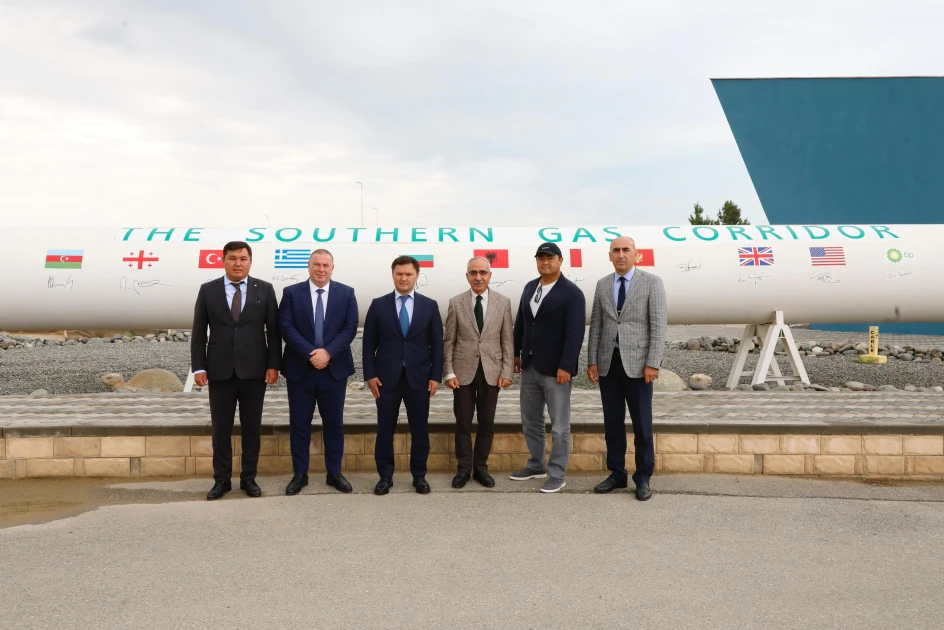
A delegation led by Askhat Khassenov, Chairman of the Management Board of Kazakhstan’s national oil and gas company KazMunayGas, visited the Sangachal Terminal on July 25.
The guests were accompanied throughout the visit by the management of SOCAR Midstream Operations.
Givami Rahimli, bp’s Chief Advisor for Government Affairs, provided the delegation with a comprehensive overview of the chronology of Azerbaijan’s oil industry history.
The visit began at the Caspian Energy Centre, which presents a detailed account of Azerbaijan’s oil and gas heritage. The opening of the Centre coincided with the inauguration of the Azerbaijani section of the Baku-Tbilisi-Ceyhan (BTC) Main Export Oil Pipeline. The ceremony, held on May 25, 2005, was attended by Azerbaijani President Ilham Aliyev, former Turkish President Ahmet Necdet Sezer, former Georgian President Mikheil Saakashvili, former Kazakh President Nursultan Nazarbayev, former U.S. Secretary of Energy Samuel Bodman, Prince Andrew of the United Kingdom, former bp Group Chief Executive Lord John Browne, and senior officials from shareholder countries.
It was noted that President Ilham Aliyev and Prince Andrew jointly cut the ceremonial ribbon to officially open the Caspian Energy Centre. As a symbolic gesture during the ceremony, the distinguished guests left their handprints on plaster bricks, which later became one of the Centre’s defining symbols.
Rahimli highlighted several milestones achieved by Azerbaijan in the oil industry. He noted that the world’s first industrially drilled oil well was completed in 1846 in the Bibiheybat area of Baku. In 1878, the Zoroastr, launched by the Nobel Brothers on the Caspian Sea, became the world’s first oil tanker. The Baku-Batumi pipeline, constructed between 1897 and 1907, became the world’s longest oil pipeline of its time, stretching 833 kilometers.
The delegation was also informed that the internationally renowned Rothschild family and the Nobel Brothers began their business activities in Azerbaijan during the second half of the nineteenth century. It was further noted that the funds generated from Alfred Nobel’s shares in Baku oil fields contributed to the establishment of the prestigious Nobel Prize.
Azerbaijan was also the first country in the world to begin offshore oil production in 1949, extracting oil from the Neft Dashlari (Oil Rocks) field in the Caspian Sea. The platform was later recognized in the Guinness Book of Records as the world’s first offshore oil platform.
The guests were informed that following the restoration of its independence in 1991, Azerbaijan entered a new era in oil and gas development. By balancing the interests of global and regional powers, Azerbaijan, together with bp and its partners, implemented some of the largest oil and gas projects in the Caspian region and developed critical infrastructure that has significantly contributed to Eurasian energy security.
The delegation then toured the operational area of the Sangachal Terminal by bus and inspected its facilities.
They received a detailed briefing on the terminal’s technological processes. As the main hub for receiving, processing, storing, and exporting crude oil and gas produced from fields in the Caspian Sea, the terminal handles oil from the Azeri-Chirag-Gunashli (ACG) fields and gas from the Shah Deniz field. These resources are exported to international markets via the Baku-Supsa Pipeline, the Baku-Tbilisi-Ceyhan (BTC) Pipeline, and the South Caucasus Pipeline. The Sangachal Terminal has the capacity to process 1.2 million barrels of crude oil per day and 81 million cubic meters of gas per day. Its crude oil storage capacity is nearly 4 million barrels. Covering more than 688 hectares, it is recognized as one of the world’s largest integrated oil and gas terminals. Operations originating from Sangachal play a vital role in diversifying global energy supplies and strengthening energy security.
The delegation was also briefed on the terminal’s capability to transport third-party crude oil, in addition to Caspian production, through the Baku-Supsa and BTC pipelines. Detailed information was provided on the entire process chain, from production and operations to volume measurement, custody transfer, volume control, and pipeline system safety management.
At the conclusion of the visit, Givami Rahimli, on behalf of bp, presented Askhat Khassenov, Chairman of the Management Board of KazMunayGas, with a symbolic oil barrel and a copy of “The Magical Tales of Tabriz”, a book dedicated to the art of Azerbaijani miniatures.