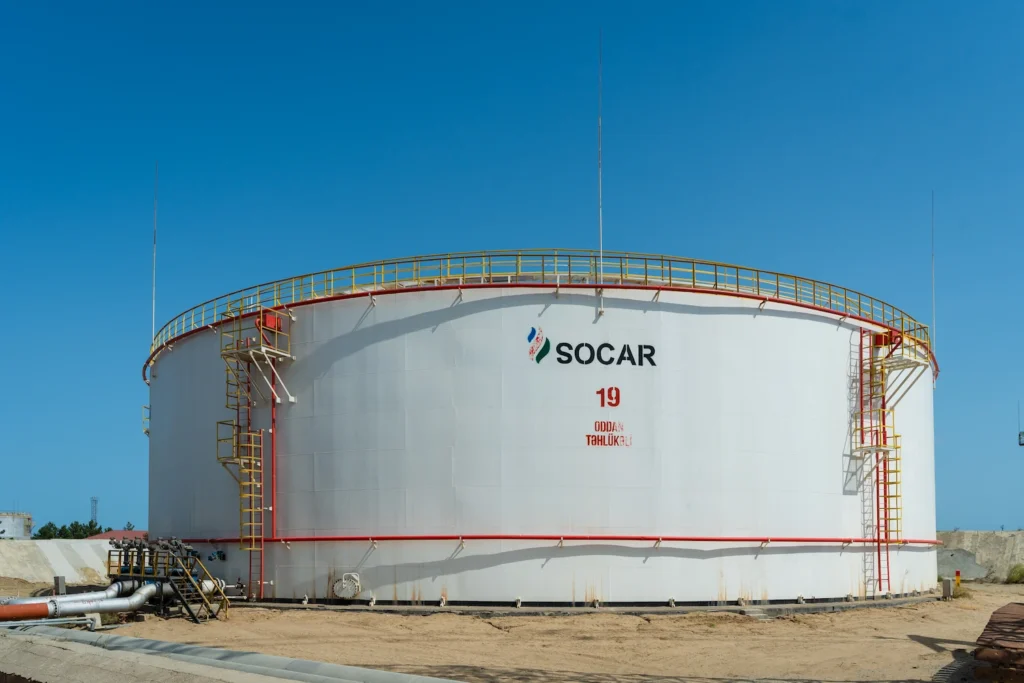
Dubendi Oil Terminal, a structural unit of SOCAR’s Oil Pipeline Department, is located 45 km from Baku, in the North Absheron port of Pirallahi district, near the settlement of the same name.
The Dubendi Oil Terminal was built and put into operation in 1971. Later, the terminal was upgraded and has been expanded at various times. The design capacity of Dubendi Terminal, which covers a total area of 106.31 hectares, currently allows 20 million tons of products to be received and transported each year. The main operating principle of the terminal is the reception, packaging and transportation of offshore oil, as well as transit oil and oil products imported by sea from the Caspian republics. The Dubendi Oil Terminal transports crude oil received from the Oil Rocks, Absheronneft and 28 May Oil and Gas Production Departments via the 500 mm Dubendi-Boyuk Shor-Sumgayit pipeline, commissioned in 1972, to Baku-Novorossiysk and Baku-Tbilisi-Ceyhan export pipelines. The design capacity of this pipeline allows it to transport 7 million tons of oil per year. Moreover, the terminal transports crude oil to the Heydar Aliyev Oil Refinery via the 700 mm Dubendi-Boyuk Shor pipeline, which was commissioned in 1976 and has a design capacity of 9 million tons per year, as well as the 300 mm Dubendi-Surakhany-Boyuk Shor pipeline commissioned in 1984 with a capacity of 2 million tons per year.
To carry out all the foregoing operations, the Dubendi Oil Terminal uses 3 main pumping stations consisting of 55 commodity oil tanks and 16 pumping units, as well as internal technological oil pipelines of different diameters with a total length of 37.6 km.
Additionally, Berths No. 1 and No. 3 at the Dubendi Oil Terminal, each with an annual cargo-handling capacity of 5 million tonnes, are currently in operation. Furthermore, in accordance with the “Improvement Program” project for the oil import, transportation, and export system, reconstruction works on Berth No. 2 are currently underway.
The main working principles of the Dubendi Oil Terminal are the overhaul of facilities and equipment for the reception, storage and transportation of oil, the implementation of reconstruction work, and the provision of oil transportation in strict compliance with the technological mode of operation.